I had a coach once who asked me a great question in our third session: "What happened with that engineer you mentioned last time?" And I couldn't answer. Not because nothing had happened. Plenty had happened. I just hadn't written any of it down, and six weeks later the details were gone. I told him some version of it, probably slightly flattering to myself, and we worked from that.
That's the moment I realized coaching has a raw materials problem. A coach can only work with what you bring into the room. And most of us bring a cleaned-up, half-remembered version of reality.
I'm biased here, obviously. I built a journaling app. But I built it because I think daily reflection is the most underused tool in a manager's development, and the one that makes everything else (coaching included) actually work.
Side-by-side comparison
| Manager Journaling | Executive Coaching | |
|---|---|---|
| Cost | Free to ~$10/month with a purpose-built app | $200-500/hour (per the ICF Global Coaching Study, 2023); typical engagements $5,000-20,000/year |
| Frequency | Daily, a couple of minutes per session | Monthly or bi-weekly, 45-90 minutes per session |
| Context | Based on what you actually experienced, captured same-day | Based on what you share in the session, often weeks-old memory |
| Privacy | Completely private if on-device; you write without an audience | Shared with a coach; confidential but not private |
| Feedback source | AI pattern recognition across your entries | External human perspective; challenge and accountability |
| Scales with time | Yes, patterns compound across weeks and months | Limited, with a defined scope and end date |
| Availability | Any time, any day, no scheduling | Scheduled sessions; typically once a month |
| Blind spots | Won't challenge what you've normalized; no external perspective | Requires you to surface issues; coach can only work with what you share |
What journaling does that coaching can't
When you write privately with no audience, you're more honest. Not because coaching conversations are dishonest, but because private writing doesn't have the subtle performance that comes with another person in the room. You write what actually happened, including the parts that don't reflect well on you.
Journaling is also continuous. A coaching session happens once a month. The situations that need reflection happen every day. By the time you sit down with your coach, you've already lost most of the detail. Journaling captures it while it's fresh, before memory edits it and before you've decided what it means.
And then there's the record itself. After six months of daily reflection, you can see how you've changed as a manager. That longitudinal view is something a coaching engagement doesn't typically produce.
What coaching does that journaling can't
The most valuable thing a coach provides is the view from outside. They see patterns you've normalized. They ask questions you wouldn't think to ask yourself. They hold you accountable to commitments you made but would otherwise rationalize away.
Journaling is self-directed. You see what you're primed to see. A skilled coach sees the version of events you're presenting and probes what you're not saying. That's a fundamentally different kind of feedback.
Coaching also works well for specific challenges that benefit from dialogue: navigating organizational politics, preparing for a career move, or working through an interpersonal situation where your own reasoning may be compromised.
Why I think you should start with journaling
If you have access to executive coaching through your company and you're not getting much from it, a reflection practice will change that. You'll arrive at sessions with real patterns and specific questions instead of a vague feeling that something isn't working.
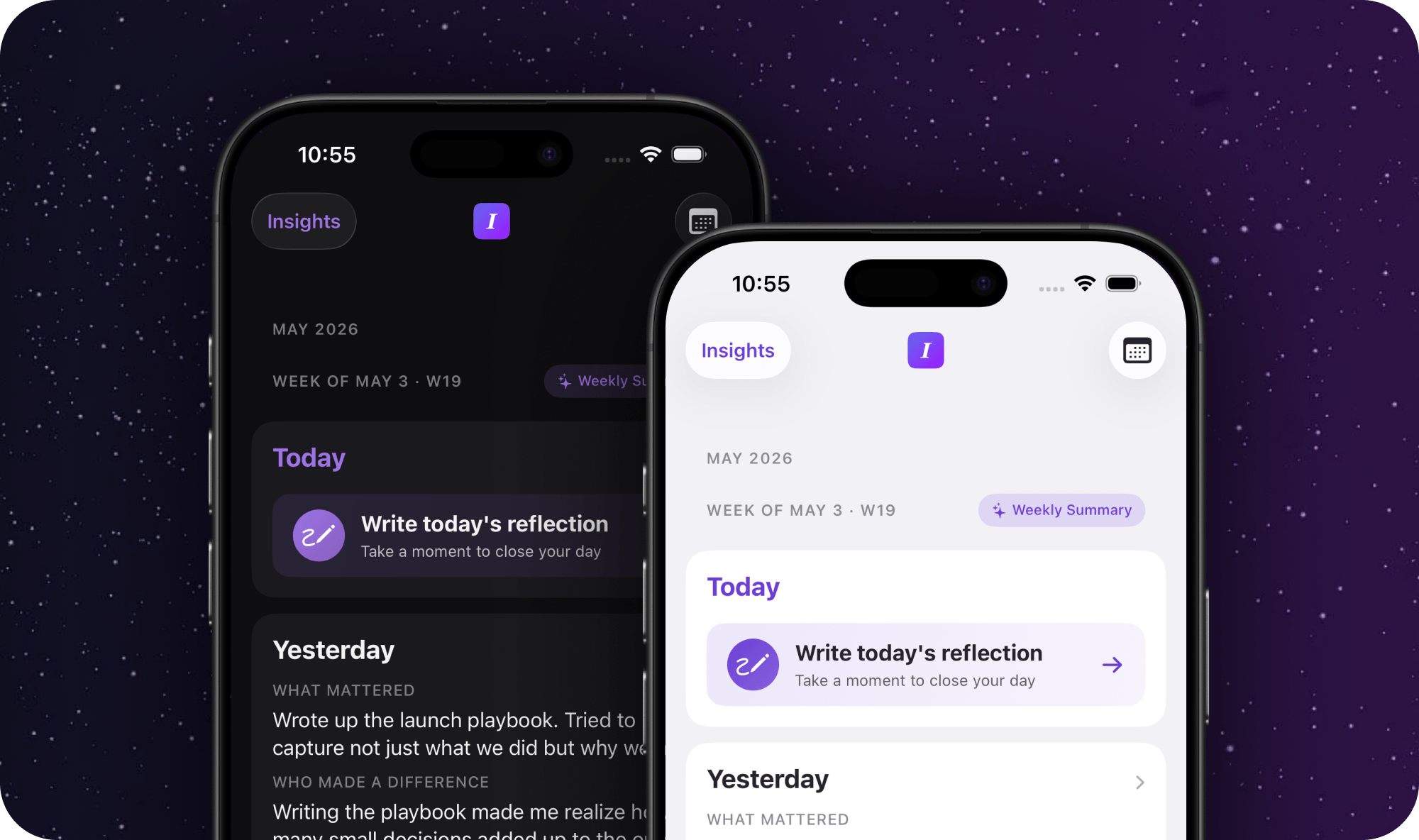
If coaching isn't available to you (and at $200 to $500 per hour according to the ICF Global Coaching Study, for most managers it isn't), journaling with a purpose-built tool like Intura covers a real portion of what coaching delivers. Weekly AI summaries surface patterns from your entries. It's not a coach, but it's a lot closer than nothing. And it costs about what you'd spend on coffee.
That coaching session I mentioned at the start, where I couldn't answer my coach's question? I still think about it. Not because the session was bad, but because it showed me the gap. The information existed. I'd lived it. I just hadn't written it down, and by the time someone asked, it was gone. That's the problem journaling solves. Not replacing the coach. Giving the coach (and yourself) something real to work with.
Frequently asked questions
Can journaling replace executive coaching?
For most managers, no. But it changes what coaching can do. Coaching works best when your coach has context, and journaling builds that context. Without reflection, coaching sessions often start from scratch. With it, you arrive with specific patterns and questions, which makes the coaching more targeted.
Is executive coaching worth the cost?
It depends on the coach and how you use the sessions. The managers who get the most from coaching are the ones who come prepared, with specific situations and questions, rather than expecting the coach to figure out what needs working on. Journaling is what makes that preparation possible.
What does journaling do that coaching can't?
Journaling is daily, private, and based on what actually happened. Not your reconstruction of it weeks later in a coaching session. A coach works from what you tell them. A journal captures what you noticed before you edited it for an audience. The honesty of private writing is different from the honesty of a facilitated conversation.
What does coaching do that journaling can't?
A good coach sees patterns you've normalized, asks questions you wouldn't ask yourself, and holds you to commitments between sessions. That external perspective is something self-reflection can't replicate. Journaling is self-directed. Coaching is other-directed. You need both kinds of feedback.
Is manager journaling only useful if you can't afford coaching?
No. Many managers who have access to executive coaching also journal. The two do different things. Journaling is an everyday practice. Coaching is periodic. The reflection habit improves the quality of both the coaching and the work in between.