Last Tuesday I sat down for a 1:1 and realized I couldn't remember a single specific thing my direct report had done that week. I knew it had been a busy week. I had a vague sense that a client call went well. But nothing concrete. I was reconstructing the week from feelings, not facts.
That's the actual problem with 1:1 preparation. It's not that managers don't care. It's that they're working from memory, and memory is terrible at this.
The memory problem
After five days, your recall of a specific conversation or situation drops by 60 to 80 percent, consistent with the forgetting curve first described by Ebbinghaus and replicated in a 2015 PLOS ONE study by Murre and Dros. That's not a failure of effort. It's how episodic memory works. You remember that a conversation happened and roughly how it felt, but the detail that made it matter is gone.
So the preparation session becomes a retrieval effort. You're sitting there trying to reconstruct what happened rather than reviewing what you already know. That's backwards.
How to prepare for a 1:1
- Review your notes from the past week. If you reflect daily, this takes a couple of minutes. Look for anything involving this person: decisions they were part of, blockers they mentioned, context you picked up that they may not know you noticed.
- Check your open threads from the last 1:1. What did you say you'd follow up on? What did they raise that didn't get resolved? A 1:1 without continuity from the previous one is just a disconnected conversation. It's not a developing relationship.
- Pick one thing to acknowledge. Something specific they did this week that was good. Not generic praise. Specific and observed. "You handled the client call on Wednesday without escalating, even though it was tense." That signals you're paying attention.
- Pick one thing to explore. A question you genuinely don't know the answer to. About their energy, a project they're leading, something you noticed that you want to understand better. Not a question where you already know what you want to hear.
- Know what you're bringing. Is there something you need from them? Context on a decision, a heads-up about a change, feedback on your own behavior? Come with at least one thing you're contributing, not just facilitating.
What to leave unscripted
Over-prepared 1:1s become performance reviews in disguise. Leave 40% of the time without a plan. The best conversations in 1:1s usually start with "there's something I've been thinking about," and those moments only happen if there's space for them.
Preparation is what lets you be present. If you're working through a list, you're not actually listening.
Good 1:1 preparation vs. bad 1:1 preparation
| Good preparation | Bad preparation |
|---|---|
| Review written notes from the past week | Try to remember what happened since the last meeting |
| Check one or two open threads from last time | Start fresh with no continuity |
| Have a specific thing to acknowledge and a genuine question | Build a full agenda with all talking points scripted |
| Leave space for what they want to bring | Fill the time so there's no awkward silence |
| Know your own ask or update | Use the 1:1 only to check on their work |
The role of daily reflection
The best 1:1 preparation isn't really a preparation session. It's the few seconds at the end of each day where you note what mattered, including anything about your direct reports. Gallup's State of the American Manager report (2015) found that employees who have regular one-on-ones with their manager are three times more likely to be engaged, which makes the quality of that preparation worth getting right. Over a week, those entries become the raw material for preparation that actually has depth.
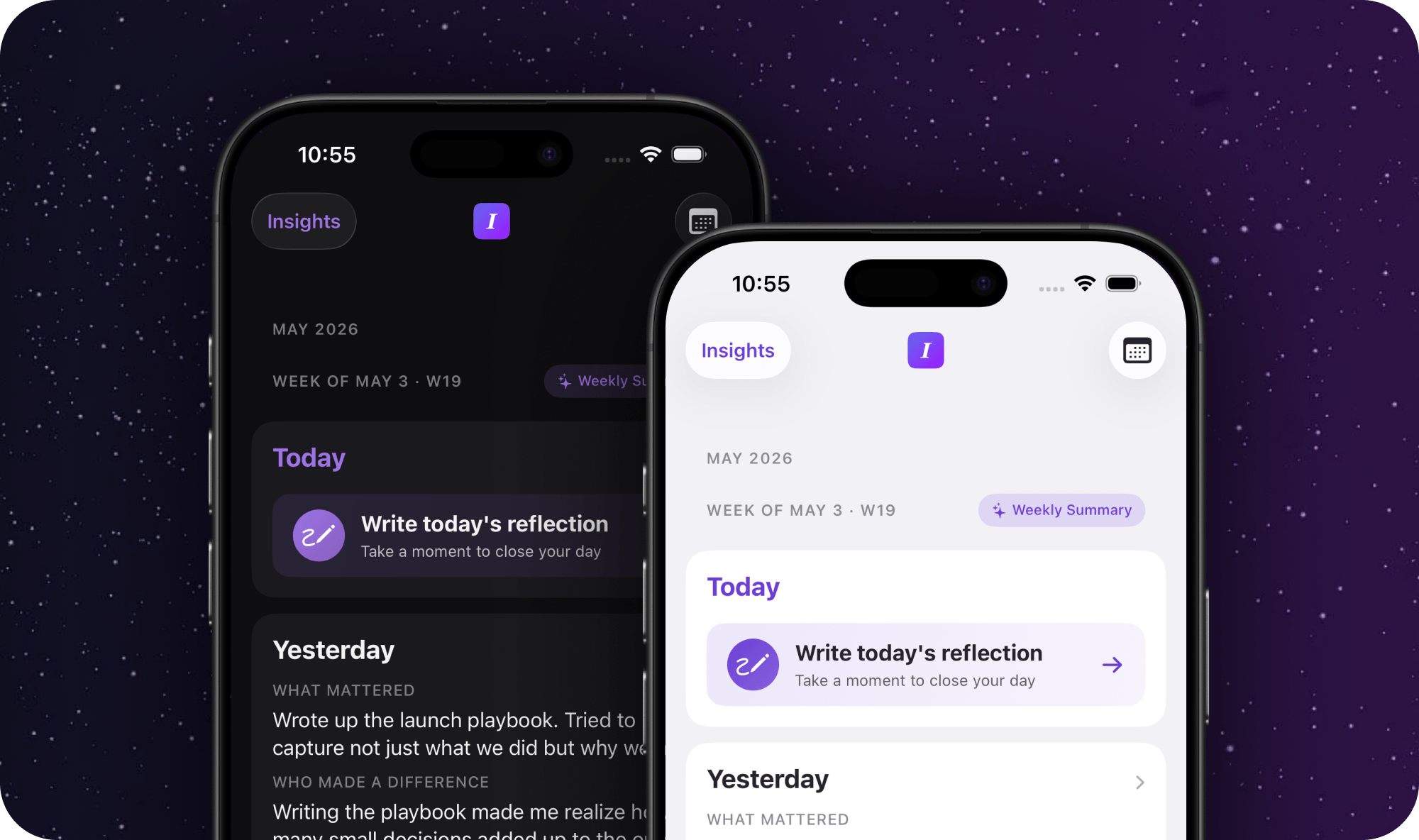
Intura is designed for this: daily manager reflection prompts, a private record on your device, and an AI summary every week that surfaces patterns before your 1:1s. The preparation becomes a quick review rather than a reconstruction from memory.
That Tuesday 1:1 I opened with? I went back and looked at my notes afterward. The thing I couldn't remember was a conversation about workload. It had happened on Wednesday, and by the following Tuesday it was gone. Five days. If I'd written one sentence that evening, I would have walked in ready. That's the gap this whole approach closes.
Frequently asked questions
How long should 1:1 preparation take?
A few minutes, if you've been reflecting throughout the week. The preparation isn't a separate activity. It's a review of notes you've already taken. If it takes longer, you're trying to do reflection and preparation at the same time, which never works as well.
What if I don't have any notes to review?
Then you're preparing from memory, and memory gets unreliable fast. After a few days, the details blur together. The fix isn't better preparation. It's building a daily reflection habit so you always have something written down before your 1:1s.
Should I share my preparation notes with my direct report?
Your preparation notes are for you, not for them. They help you walk in with context and a clear intention for the conversation. What you share during the 1:1 itself is a separate decision. Don't conflate your private thinking with the conversation.
How do I handle a direct report who doesn't prepare for 1:1s?
Ask them to bring one thing they want to discuss. That's enough to start. Don't require a formal agenda. That raises friction and creates performative preparation. One topic, no format, come ready to talk.
What's the right cadence for 1:1s?
Weekly for direct reports. That's what works for most managers. Bi-weekly creates too much lag: you lose context between sessions and the relationship becomes transactional. Monthly is almost always too infrequent to be developmental.